The Crescendo at the Countertop: A Private Equity Exit via the Capital Markets
Executive Summary
The QuickMart PLC Initial Public Offering (IPO) opened on October 5, 2026, and closes on October 30, 2026, with selling shareholder Sokoni Retail Kenya Limited offering 2,000,000,000 ordinary shares (a c. 50% post-offer float) at KES 7.50 per share to raise KES 15.0Bn. Structured strictly as a secondary offer for sale, QuickMart will receive no net proceeds from the transaction; physical store expansion and digital initiatives will remain fully funded through organic operating cash flows and existing credit lines.
The business is Kenya’s second-largest supermarket chain by store count and revenue, operating 73 leased outlets across 16 counties. Its core merchandise strategy focuses on fast-moving consumer goods, with Food (52%) and Fresh Produce (12%–13%) generating c. 65% of total sales. The business operates an asset-light model by leasing 100% of its stores. Managed through a standardized six-month rollout, new stores are reported to achieve EBITDA break-even in their first month, mature within 12 months, and achieve full capital payback within two to three years. Its medium-term strategy centres on expanding its footprint to 125 domestic locations by 2030. Simultaneously, the company plans to scale its digital and e-commerce channel, QSOKO, to contribute over 10% of total revenue.
Primary investment risks
Thin Liquidity Buffers: While operating thin cash reserves relative to balance sheet size has effectively sustained the business through high inventory turnover and disciplined working capital management, this standard negative working capital model carries unique structural vulnerabilities within an East African context, a risk that historical domestic retail failures illustrate. Minimal cash buffers provide virtually no insulation if suppliers compress payment terms or mandate cash-on-delivery during temporary liquidity troughs.
Competition & Store Concentration: Approximately 60% of QuickMart’s c.73 stores are concentrated in the dense Nairobi Metropolitan Area – a market hosting c. 200 of Kenya’s c. 500 modern trade outlets. This high geographical density exposes QuickMart to aggressive promotional pricing and margin compression from market leaders who leverage greater volume scale for preferential vendor terms. Additionally, fast-growing regional chains may drive up deposits and commercial lease rates across QuickMart’s 100% leased footprint.
E-Commerce Economics: Direct online fulfilment carries high last-mile logistics expenses that are margin-dilutive, while relying on third-party aggregators (e.g., Glovo, Bolt) incurs merchant commissions and weakens direct customer retention. Compounding this, well-capitalized international peers like Carrefour can leverage larger balance sheets, giving them an e-commerce edge that may threaten to squeeze QuickMart in this fast-growing urban market segment.
Valuation
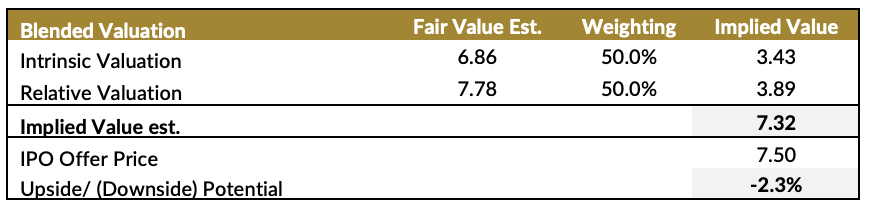
We performed a blended valuation taking into account intrinsic (DCF & DDM) and relative (P/E, P/B, EV/EBITDA) methodologies to estimate the fair value of QuickMart PLC. Our model derives a consolidated fair value estimate of KES 7.32 per share. This indicates that the IPO offer price of KES 7.50 per share represents a slight premium (+2.3%) over the blended intrinsic and peer-based valuation, suggesting near-term operational growth and market positioning are fully priced into the offer.