Seeing Through the Fog
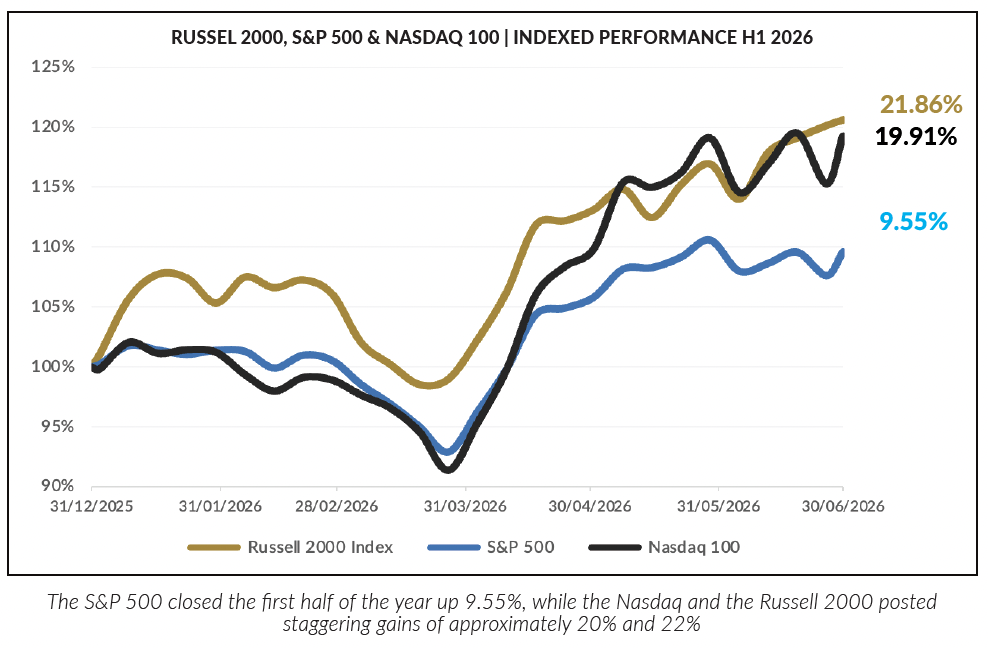
The Bears make sense but the bulls make money. It is a Wall Street aphorism that has never felt more prescient than at the midpoint of 2026. If you were to look purely at the macroeconomic ledger for the first half of the year, one would be forgiven for being rattled & adopting a defensive stance. After a bruising first quarter, any rational observer might have looked at these geopolitical fault lines, the rising cost of capital, and the dizzying valuations of technology mega-caps, and conclude that caution was the only logical posture. And yet, the equity markets delivered a masterclass in resilience, climbing a wall of worry to build a smooth escalator to the stratosphere. The S&P 500 had its best quarter since 2020 to close the first half of the year up 9.55%, while the Nasdaq and the Russell 2000 posted staggering gains of approximately 20% and 22%, respectively. Not bad for a market that, just three months earlier, many had written off as heading for a prolonged downturn.
To understand the triumph of Q2, one must first appreciate the ordeal of Q1. The year opened with familiar tensions — Trump tariff threats, policy uncertainty, and a technology sector grappling with questions about the sustainability of its AI-fueled valuations. Markets were already on edge when, in late February, the US and Israel launched military operations against Iran, triggering a conflict that would define the first half of 2026. The Strait of Hormuz — a narrow waterway through which a significant portion of the world’s oil flows — was effectively shut down, sending Brent crude surging above $100 a barrel for the first time since 2022. The Nasdaq 100 fell into correction territory, the S&P 500 logged its longest losing streak in four years, and some $6 trillion in global equity market value was wiped out in the span of a single week in March. Goldman Sachs’ trading desk, never one to mince words, warned clients that “the only way up is down from here.” It was, in short, the kind of period that makes market participants question their life choices.
Even as the bombs fell and oil prices soared, something quietly remarkable was happening beneath the surface: Corporate America was making money — a lot of it. Earnings for Q4 2025 and Q1 2026 came in with extraordinary strength, with 83% of S&P 500 companies beating analyst expectations by the time the reporting season wound down — the highest beat rate since 2021. Industrial companies delivered the biggest earnings surprise of any sector, powered by defense demand, commercial aerospace, and AI-related capital spending. Morgan Stanley’s Mike Wilson was among those noting that the profit boom was intact despite the war, with S&P 500 earnings expected to rise 20% over the next twelve months. The market, it turned out, had been listening to the earnings instead of the headlines.
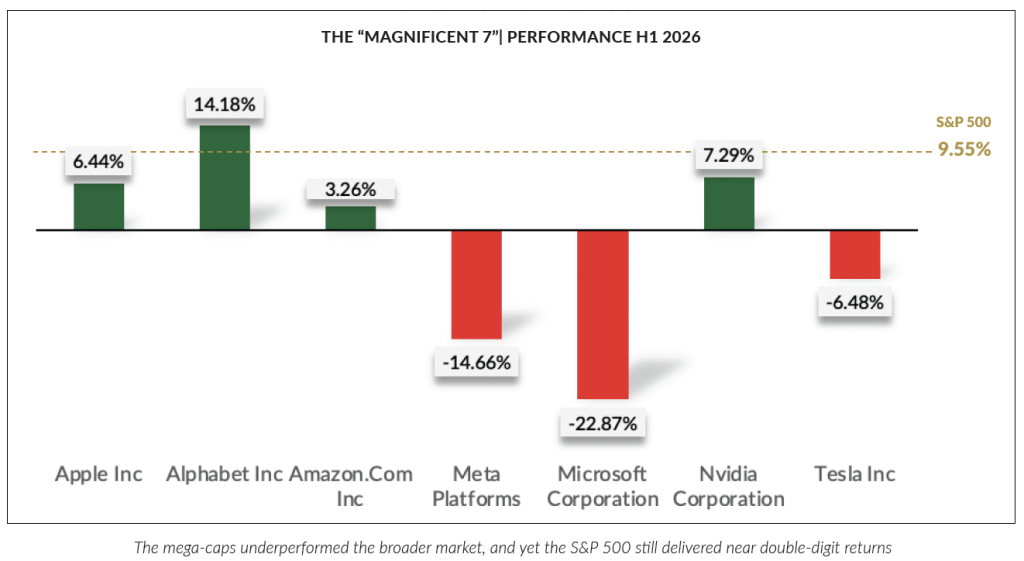
The pivot from despair to euphoria came swiftly. April marked the beginning of a stunning reversal, as peace negotiations between the US and Iran gathered momentum and oil prices began their long retreat from triple-digit territory. Markets responded with the kind of relief rally that reminds you why staying invested through the noise is so often the right call. The S&P 500 hit fresh record highs, the Nasdaq soared, and the bears — who had made a very compelling case just weeks earlier — found themselves on the wrong side of one of the sharpest recoveries in years. What makes this performance extraordinary is the composition of the rally. For the better part of three years, the narrative of the U.S. stock market had been dominated by a singular, monolithic theme: the hegemony of the “Magnificent 7.” These technology leviathans accounted for 63%, 55%, and 46% of the S&P 500’s annual returns in 2023, 2024, and 2025, respectively, masking a sea of underperformance beneath the surface but also showcasing lesser dependence on the cohort as the years went on. The first half of 2026 then marked a profound, tectonic shift in this dynamic. The mega-caps underperformed the broader market, and yet the S&P 500 still delivered near double-digit returns because the remaining 493 constituents finally woke up. Nearly 45% of the stocks in the S&P 500 outperformed the benchmark in the first half of the year, creating a rich environment for fundamental stock selection.
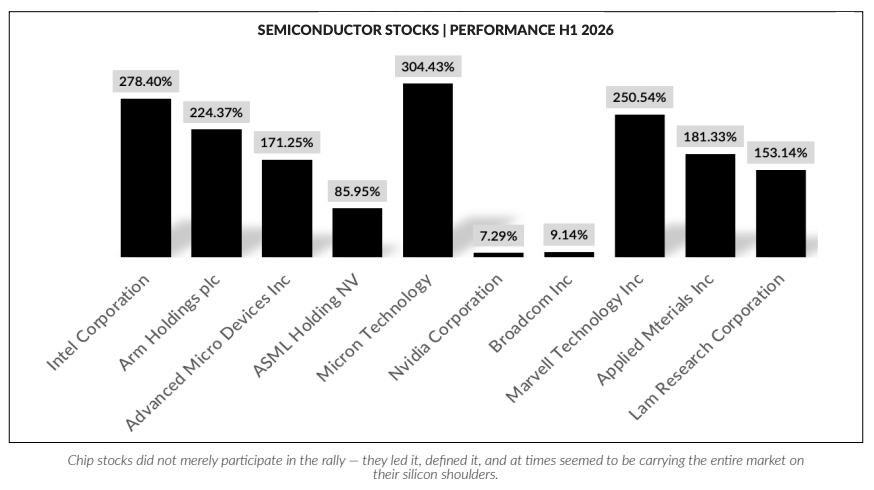
The undisputed hero of this recovery were semiconductors. Chip stocks did not merely participate in the rally— they led it, defined it, and at times seemed to be carrying the entire market on their silicon shoulders. The AI infrastructure buildout, far from showing signs of fatigue, accelerated dramatically through April and May. Hyperscalers — Meta, Microsoft, Amazon, Alphabet & Oracle — continued to pour capital into data centers at
a pace that left even optimistic analysts scrambling to revise their forecasts upward, with Meta alone flagging plans to spend as much as $135 billion in 2026. The result was a memory chip shortage that became one of the defining supply-demand stories of the year, with Micron Technology surging approximately 260% year-to-date by late June, and Sandisk posting a staggering 258% gain in Q2 alone. Micron’s late-June earnings report, which guided for approximately $50 billion in revenue for its fiscal fourth quarter, served as the exclamation point on the semiconductor story — and a fitting crescendo to a quarter that the chip industry will be talking about for years.
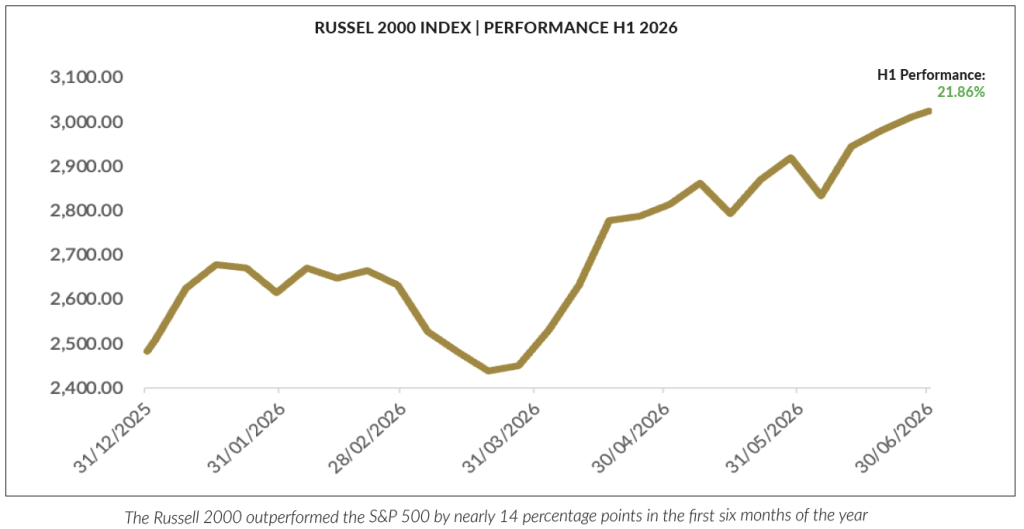
Yet for all the fireworks in chips and mega-cap tech, one of the more quietly significant stories of the first half was the rotation happening beneath the index level. The absolute explosion of the Russell 2000 — home to America’s smaller, scrappier companies — outperformed the S&P 500 by nearly 14 percentage points in the first six months of the year, a gap that, if sustained through year-end, would be the largest small-cap outperformance in over two decades. Long viewed as highly sensitive to interest rates and crowded with unprofitable “zombie” companies, the conventional wisdom dictated that small caps were uninvestable. The conventional wisdom was spectacularly wrong as 10 out of the 11 sectors in the index were higher. The fundamental justification for this small-cap euphoria is rooted in forward earnings expectations. Bottom-up consensus estimates suggested the Russell 2000 was on track to deliver a staggering 43% year-over-year earnings growth over the forward twelve months, compared to the S&P 500’s respectable, but smaller, 21% estimates. This was clearly not a market running on fumes from a handful of giants alone; it was a market where earnings momentum was broadening, cyclical sectors were finding their footing, and investors were beginning to look beyond the AI trade for opportunities. Easing oil prices, a softening dollar, and reduced rate pressure were cited as catalysts for a further broadening of the rally into more economically sensitive industries — and for once, the rest of the market was more than happy to pick up the baton.
Then came the moment that stopped the entire financial world in its tracks as the most consequential, disruptive event to hit public market capitalism since the dot-com era: the initial public offering of Space Exploration Technologies Corp (SpaceX). On June 12, Elon Musk’s rocket, satellite, and artificial intelligence company made its public market debut on the Nasdaq exchange, raising $75 billion in the largest IPO in history, more than double the size of Saudi Aramco’s landmark 2019 listing. When the stock began trading, a cocktail of retail fervor and demand from sovereign wealth funds from the Gulf clamoring for a piece of the action, institutional giants like BlackRock targeting allocations of up to $5 billion combined with a severely restricted public float of just 4.2% pushed the stock to an intraday all-time high of $225.64—a 67% gain from its IPO price in just three trading sessions, temporarily pushing its valuation past $2.2 trillion as the offering had been more than four times oversubscribed. This turned Elon Musk into the world’s first trillionaire. The deal was more than a capital markets milestone; it was a cultural moment, a signal that the era of mega-private companies staying private indefinitely was drawing to a close, and that public markets still had the appetite and the depth to absorb the very largest ambitions on earth. As we headed towards the end of the quarter, this Mega-IPO acted as a gravitational black hole, sucking liquidity away from the rest of the market.
Into this already euphoric atmosphere stepped a new sheriff at the Federal Reserve — and he arrived with a very different disposition than markets had hoped for. Kevin Warsh, sworn in as Fed Chair on May 22, wasted no time making his priorities clear. Where markets had spent much of 2025 pricing in rate cuts, Warsh arrived talking tough on inflation during his first FOMC meeting in June, engineering a dramatic, hawkish pivot. He issued a hyper-concise, 130-word policy statement that completely eliminated forward guidance, and he refused to submit his own personal rate projection to the Fed’s ‘dot plot’. The rest of the committee raised the median projected 2026 federal funds rate to 3.8%, effectively pricing out any guarantee of rate cuts in 2026 and bond traders listened as yields shot up with 30-year treasury yields touching the highest level since 2007. The Warsh doctrine represented a paradigm shift: equities must trade entirely on their fundamental earnings merit, without the crutch of imminent monetary easing. A hawkish Fed arriving precisely as the geopolitical relief rally was in full swing was the kind of cold shower that, in any other environment, might have derailed the party entirely. That it did not — and that equities closed the quarter at record highs regardless — speaks volumes about the underlying earnings momentum that has been the market’s most durable anchor throughout this extraordinary half-year. Warsh did offer some late reassurance, noting at the ECB’s annual forum in Sintra at the end of June that inflation risks had “come down” in recent weeks — a subtle but meaningful softening of tone that gave equity markets the permission they needed to close the books on a remarkable quarter.
As the first half of 2026 closed the books, the S&P 500 stands on a solid footing by any historical standard, even if the headline gain masks the extraordinary divergence between AI-adjacent winners and the rest of the market. The earnings story remains the market’s most durable foundation, with profit margins at their richest in at least 15 years. The geopolitical backdrop, however, remains unresolved — the Iran ceasefire is fragile, oil markets are volatile, and a new Fed Chair with a hawkish mandate who is still rearranging the furniture. The SpaceX IPO opened a new chapter for public markets, but it also raised the bar for what comes next. The second half opens with fresh uncertainty on every front. The bears, as always, will have their arguments ready. History, and the first half of 2026, suggest the prudent response is to listen carefully — and then remember who tends to make the money.