The Islamic Development Bank Group projects that global Islamic finance assets will
reach US$9.7 trillion by 2029, expanding at an average annual rate of 10%. This
growth reflects a rising demand for financial solutions anchored in ethical investment,
shared prosperity and sustainable economic development.
Africa is emerging as one of the industry’s important growth frontiers. According to
the 2025 Islamic Financial Services Industry Stability Report by the Islamic Financial
Services Board (IFSB), emerging markets, particularly in Africa and Central Asia, are
creating new opportunities for Islamic finance.
In Kenya, financial inclusion has evolved beyond access to banking services. It
increasingly encompasses access to financial solutions that respond to investors’
beliefs, values and long-term aspirations. Over the past decade, Shariah-compliant
products have emerged as both an alternative and a complement to conventional
finance, widening participation for individuals and institutions seeking faith-aligned
investment opportunities.
Islamic finance is founded on principles that promote fairness, transparency and
responsible enterprise. It prohibits interest (riba), excessive uncertainty (gharar) and
investment in activities that are inconsistent with Islamic values, including alcohol and
gambling. Instead, it encourages investment in real economic activity, responsible
trade and the sharing of risk and reward.
These principles extend beyond commercial activity to social welfare through Zakah,
voluntary charity (Sadaqah) and endowments (Waqf), reinforcing the role of finance as
an instrument for social and economic inclusion.
Globally, Islamic investment funds recorded modest growth in 2024, supported by
equity market performance, according to the IFSB. Yet the industry remains
fragmented, with many small-sized funds facing scale limitations. The growing interest
in sustainable sukuk and Islamic funds also signals untapped potential as investors
increasingly seek financial returns alongside ethical and environmental responsibility.
Technology is further reshaping the industry, enabling financial institutions to reach
broader audiences more efficiently and deliver inclusive, accessible investment
solutions.
Against this backdrop, SIB Najah, the Islamic Investment Banking division of Standard
Investment Bank, is helping expand access to Shariah-compliant wealth management
in Kenya. The division combines the institutional strength of Standard Investment
Bank with Islamic finance principles to serve individual, corporate and institutional
investors.
“Through SIB Najah, investors can invest with confidence, diversify globally and pursue
their financial goals in a Shariah-compliant manner,” says Abdullahi Omar Adan,
Executive Director, Islamic Investment Banking at Standard Investment Bank.
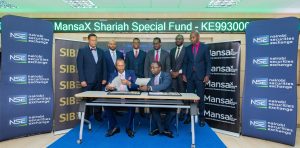
SIB Najah’s flagship product, the Mansa-X Shariah Fund, is a Capital Markets
Authority-regulated, multi-asset investment fund offering KES and USD options. The
fund invests in screened Shariah-compliant assets across global markets, providing
investors with a professionally managed avenue for ethical diversification.
Its compliance framework is overseen by an independent Shariah Advisory Board,
whose members provide guidance and screening to ensure investment decisions
remain aligned with Islamic principles.
Since its inception in October 2023, the Mansa-X Shariah Fund has grown to become
the largest regulated shariah compliant fund in Kenya with combined assets under
management of KES 3.8 billion as at May 2026. In 2025, the KES fund delivered a net
return of 17.25%, while the USD fund achieved a net return of 11.65%—their strongest
annual performances since inception.
As Kenya advances its financial inclusion agenda, Shariah-compliant investment
solutions are demonstrating that wealth creation can be both commercially compelling
and firmly grounded in values.